
In plastic extrusion, precise vacuum control directly impacts product dimensional tolerances, surface finish, and structural integrity. Two critical stages in the extrusion process rely heavily on liquid ring vacuum technology:
Vacuum Calibrator Baths (sizing tanks) and Extruder Barrel Venting.
Understanding the unique operating demands of each application helps extrusion line operators select the right vacuum pump technology to maintain consistent output and reduce maintenance downtime.
-
Plastic Extrusion Vacuum Applications
Vacuum Calibrator Baths (Sizing Tanks)
After molten polymer exits the die head, it passes into a vacuum calibrator bath—a water-filled tank equipped with internal sizing sleeves.
- The Application: A controlled vacuum pulled inside the calibrator bath creates a differential pressure. This draws the pliable exterior of the extruded pipe, tubing, or profile outward against the sizing sleeve walls while cooling water freezes the polymer structure.
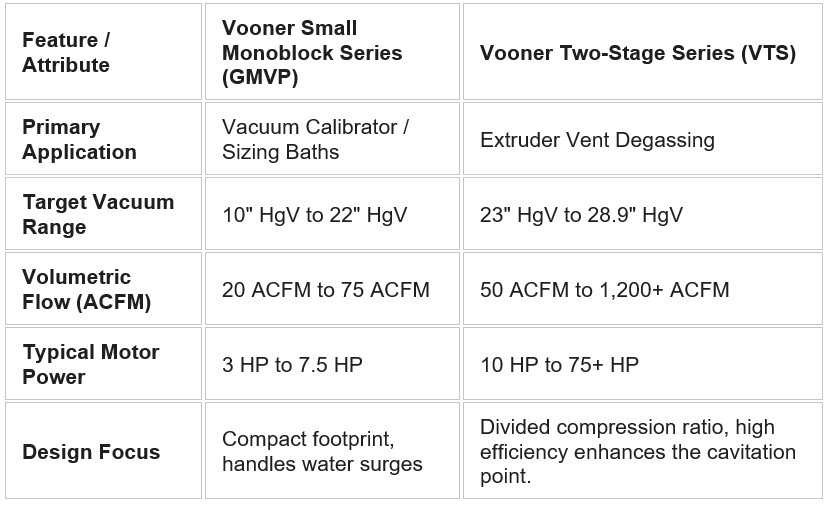
- Operating Demands: Moderate vacuum levels (typically 10″ HgV to 20″ HgV) with continuous carryover of liquid water into the vacuum line.
- Flow Measurement: System sizing relies on volumetric flow (ACFM or CFM) to properly manage entrained air and water vapor carryover at operating conditions, rather than standard mass flow calculations (Lbs/hr).
Extruder Barrel Venting (Degassing)
During polymer melting and conveyance within the extruder barrel, trapped air, surface moisture, monomer residues, and volatile organic compounds (VOCs) are released into the melt stream.
- The Application: An open vent port along the barrel allows these trapped gases to escape before the polymer is forced through the die. Applying a deep vacuum to this degassing zone prevents voids, bubbles, pitting, and optical defects in the finished profile.
- Operating Demands: Deeper vacuum levels (typically 23″ HgV to 28.5″ HgV) are required to pull trace moisture and light volatiles out of dense melt streams.
- Flow Measurement: Requires reliable volumetric suction capacity (ACFM) at low absolute pressures to maintain stable degassing without drawing molten polymer carryover into the vent line.
-
Vooner Product Application Comparison
Vooner Liquid Ring Vacuum Solutions
Monoblock Liquid Ring Vacuum Pumps for Calibrator Baths
For sizing tanks, Vooner offers close-coupled Monoblock Liquid Ring Vacuum Pumps designed specifically for rugged water-handling environments.
- Compact Footprint: The close-coupled monoblock arrangement eliminates separate baseplates and flexible couplings, saving valuable floor space on mobile calibrator tables or under sizing frames.
- Liquid Slug Resistance: Extrusion lines frequently pull cooling water liquid slugs through the suction line. Vooner monoblock pumps feature stainless steel port plates and Burgmann mechanical seals that handle continuous water carryover without stalling or damaging components.
- Corrosion Protection: Stainless steel impellers and critical internal surfaces prevent rust formation and clearance degradation during line shutdowns, preserving factory volumetric capacity (ACFM) over long operating lifecycles.
Two-Stage Liquid Ring Vacuum Pumps for Extruder Venting
For high-vacuum vent degassing, Vooner provides Two-Stage Liquid Ring Vacuum Pumps (VTS Series).
- Sustained High Vacuum Efficiency: Single-stage pumps lose volumetric efficiency (ACFM) sharply as vacuum levels exceed 23″ HgV due to internal vapor slip. Vooner two-stage pumps divide the compression ratio across two impellers in series, reducing internal heat buildup and maintaining high pumping speeds up to 28.9″ HgV.
- Condensing Effect: Recirculated seal water condenses volatile gases pulled from the polymer melt right at the pump inlet, boosting effective suction volumetric capacity (ACFM) beyond dry mechanical options.
- Low Downtime Operation: Rugged internal clearances allow small, entrained monomer fines to pass without scoring tolerances, cutting maintenance requirements compared to dry-claw or rotary vane alternatives.
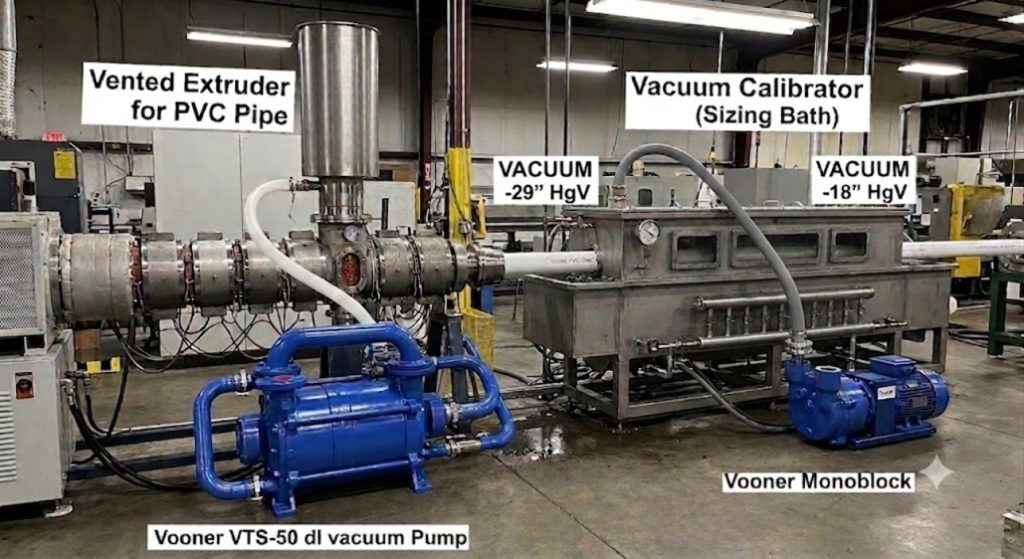
Vooner technical consulting services are available to help your team navigate these complex engineering variables, fast-tracking the selection process to deliver a reliable, highly efficient system design.
Review your application with industry specialists at Vooner – Contact Us