
A lab facility in the Denver area (about 5000 ft elevation) receives the new vacuum system with a rated end vacuum of 27”HgV (74 torr). When first started the lab manager watches the bourdon tube vacuum gauge provided with the system and it stalls out around 22”HgV. The manger quickly looks up data on-line and sees information telling him that he can expect to lose about 1” of mercury vacuum per 1000 ft elevation and believes the first process batch is ruined. Is he correct?
What is pressure anyway, and how is vacuum pressure commonly measured and used? First let’s look at the textbook definition of pressure.
P = F/A
P = pressure (psia)
F = force (pounds-force (lbf)
A = square inches (in2)
Vacuum pressure is the force resulting from trillions of gas molecules colliding with the pipe walls. The lower the pressure (partial vacuum) the lower the density of molecules and fewer particles are left to collide with the inner pipe walls. We measure this change in pressure with a variety of vacuum gauges and today we will discuss two common types found on rough vacuum systems, the bourdon tube and the capsule gauge.
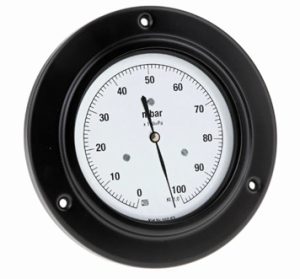
Unlike a differential gauge, a capsule vacuum gauge utilizes a sealed internal element that has been evacuated to a near-perfect vacuum. When a process vacuum is applied to the outside of this capsule, the pressure change causes the capsule to deflect, moving the pointer to register an absolute pressure level. Absolute pressure is measured relative to a perfect vacuum—a space entirely empty of molecules where pressure is exactly zero. In practical application, a perfect vacuum can never be achieved by a mechanical vacuum pump, meaning a minute amount of residual gas molecules will always remain. This absolute scale starts at zero and counts upward as mass—in the form of molecules and atoms—is added to the system.
Figure 1: The “vacuum capsule gauge”
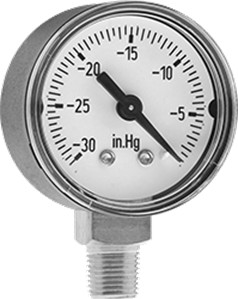
The second most common type of vacuum gauge used on rough vacuum systems is the bourdon tube gauge. This gauge records the difference in force between the outside atmosphere and the inside of the vacuum pipe. It utilizes a hollow, sealed metal tube shaped like a “C.” When a vacuum is applied to the inside of the tube, the higher atmospheric pressure on the outside causes the C-shape to curl inward or flatten slightly, which mechanically moves the pointer. This measurement scale starts at zero (local atmospheric pressure) and counts down into negative gauge pressure—or vacuum pressure—as molecules are pulled out of the pipe. Because gauge pressure ignores the absolute weight of the atmosphere and treats the ambient air as “zero,” any pressure drop below atmosphere is read directly on the dial as a vacuum.
Figure 2: “Bourdon tube vacuum gauge”
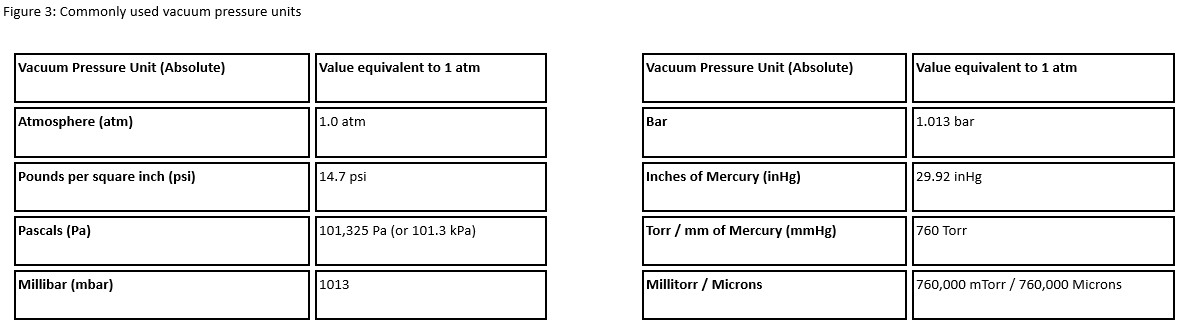
What we have established so far demonstrates that the vacuum pump does not lose its physical performance capabilities at altitude. Rather, the bourdon tube vacuum gauge is simply registering exactly what it was engineered to measure: the true pressure differential between the lower ambient atmosphere at 5,000 ft elevation and the partial vacuum inside the main facility header. Because atmospheric pressure drops by approximately 1”HgV for every 1,000 feet of elevation, a vacuum pump’s gauge reading will decrease at altitude even when its absolute performance remains unchanged. A system rated for 27”HgV at sea level is designed to leave an absolute residual pressure of roughly 2.92”HgA (74 torr) in the system. At 5,000 ft elevation, where the ambient atmosphere is only 24.89”HgA, subtracting that same residual pressure yields an expected gauge reading of approximately 22”HgV. Therefore, the gauge stalling at 22”HgV confirms the pump is operating exactly at its designed specification, and the process batch is not ruined. The best vacuum gauge for this type of system operating at altitude would be to provide with the absolute vacuum pressure gauge.
What about vacuum holding force at altitude vs sea level?
The Holding Force Rule
Holding force is entirely created by the difference in pressure between the outside air pushing down on your part and the vacuum under the part. Because atmospheric pressure is lower at 5,000 feet than at sea level, a vacuum system cannot achieve the same total pressure differential. Consequently, the holding force will be lower at altitude than at sea level. Since the bourdon tube gauge measures exactly that difference, this is the perfect device to measure the available holding force no matter the operating altitude. The formula for holding force is:
Holding Force (lbs) = Gauge Pressure times Chucking Area (sq. inches)
If you are using a standard bourdon vacuum gauge calibrated in inches of mercury (“HgV”), you just need to convert that reading to psi by multiplying by 0.491.
Gauge Pressure (psi) = Gauge Reading in “HgV * 0.491.
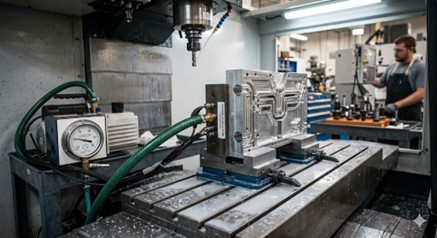
Figure 4: Vacuum is used to “chuck” parts in place while machined on a CNC table.
Review your application with industry specialists at Vooner – Contact Us