
When operating and evaluating industrial vacuum systems, a common point of confusion arises regarding air leakage rates. Specifically, engineers and operators often notice that as the vacuum level deepens (pressure drops closer to absolute zero), the calculated mass flow rate of air entering the system through leaks actually decreases. This article explores the physics behind this phenomenon using Heat Exchange Institute (HEI) standards, examines the true cost of leaks to the customer, differentiates between mechanical leakage and internal outgassing, analyzes the operational impact on vacuum boosters, and clarifies the vital distinction between mass flow and volumetric flow.
The Paradox of Lower Pressure and Lower Mass Flow
The reason the mass flow rate (in lbs/hr) decreases as the vessel pressure gets lower—even though the physical holes/leaks in the vessel haven’t changed—comes down to how gases behave at low absolute pressures. For a standard 1,000 cu ft vessel, standard HEI air leakage coefficients yield the following mass flow rates:
- 100 Torr: 18.06 lbs/hr
- 75 Torr: 14.02 lbs/hr
- 20 Torr: 9.51 lbs/hr
- Sonic Choking (Critical Pressure Ratio)
Air leaking into a vacuum system through a hole or crack behaves like flow through a nozzle or orifice:
- Atmospheric pressure outside the vessel is 14.7 psia (760 Torr).
- Once the vacuum inside the vessel drops below about 400 Torr (a pressure ratio of less than ~0.53 relative to atmosphere), the air speed through the leak reaches the speed of sound (sonic flow / choked flow).
- Once the flow is choked, the linear velocity of the air entering through the hole cannot increase any further—it is fixed at the speed of sound (c).
- Density Drop at Lower Absolute Pressures
Even though the velocity through the leak path is fixed at sonic velocity, the density of the gas inside the leak path and immediately upstream/downstream changes with vessel pressure and temperature. Per the Ideal Gas Law:
As absolute pressure (P) inside the vessel decreases:
- The mass density () of the air flowing across the boundary decreases.
- Because Mass Flow Rate = Density × Area × Velocity (), a lower density directly results in a lower mass flow rate (lbs/hr).
- Mass Flow vs. Volume Flow (CFM)
While the mass flow rate (lbs/hr) decreases as vacuum deepens, the volume flow rate at suction conditions (CFM) behaves differently:
- Mass Flow (lbs/hr): Decreases at lower pressures (18.06 → 14.02 → 9.51 lbs/hr) because there are fewer actual gas molecules per unit volume entering the system.
- Volume Flow (ACFM / CFM): Expands significantly because the gas is at a lower density/pressure. A smaller mass of air occupies a much larger volume at 20 Torr than it does at 100 Torr.
- Mechanical Leakage vs. Internal Outgassing
When evaluating system performance, it is vital to distinguish between external air leakage and internal gas evolution:
- External Air Leakage: In-leakage originating from the outside atmosphere through mechanical flanges, valve stems, weld defects, or casing cracks, governed by the choked-flow and density principles outlined above.
- Internal Outgassing: The desorption or release of trapped moisture, solvents, trapped air pockets, or volatile compounds from vessel internal walls, gaskets, porous materials, and process media. Unlike mechanical leaks, outgassing loads are largely independent of external atmospheric pressure and often dictate ultimate base pressure performance in deep vacuums.
- Impact of Excessive Air Leakage on Vacuum Boosters
In systems utilizing roots-type vacuum boosters paired in series with a primary backing pump, excessive air leakage introduces severe mechanical and thermal stress:
- Severe Overheating & Thermal Expansion: Boosters rely on gas flow to carry away compression heat without internal cooling jackets. Massive volumetric throughput causes rapid temperature increases, leading to metal thermal expansion and potential rotor-to-casing contact or seizure.
- High Differential Pressure (): Excessive in-leakage overloads the backing pump, raising interstage pressure between the booster and backing pump, which can trip bypass valves or overload drives.
- Increased Gas Slip & Loss of Efficiency: Higher inlet pressures and density cause a larger percentage of gas to slip backward across the tight rotor clearances, degrading volumetric efficiency.
- Motor Overloading: Because power draw is proportional to volumetric flow and differential pressure (), leaked air spikes motor horsepower requirements and triggers thermal overloads.
- Mechanical Wear & Vibration: Severe aerodynamic loads and high torque pulsation degrade timing gears, bearings, and shaft seals prematurely.
The Cost of Leaks to the Customer
Even though the mass of air entering a vessel decreases at deeper vacuums due to choked flow and lower density, air leaks impose substantial financial and operational costs on the plant:
- Excessive Energy Consumption: Vacuum pumps and boosters must work significantly harder to handle the massive volumetric expansion (ACFM) and high differential pressures of leaked air at deep vacuum levels, directly driving up plant electricity bills.
- Compromised Product Quality and Yield: In processes like distillation, drying, or degassing, unmanaged air leakage increases partial pressures, ruins product purity, extends batch times, and can lead to entire ruined batches costing thousands of dollars in lost raw materials.
- Condenser Performance Degradation (Power Generation): In applications such as power plant surface condensers, unmanaged air leakage blankets tube bundles, severely degrading heat transfer coefficients, increasing turbine backpressure, and directly reducing megawatt output and overall plant heat rate efficiency.
- Premature Equipment Wear: Operating pumps and boosters continuously at higher capacities or fighting unaddressed leaks accelerates wear on internal components, seals, and motors, resulting in frequent maintenance, costly replacement parts, and unplanned downtime.
- Increased Utility / Seal Fluid Costs (Liquid Ring Systems): If the system utilizes a liquid ring vacuum pump, deeper vacuum operation and unmanaged leaks require higher seal water flow rates (or colder seal water) to maintain vacuum integrity, prevent cavitation, and manage heat of compression, thereby raising water consumption and treatment expenses.
Vacuum Leak Testing & Inspection
Detecting and quantifying air leakage in industrial vacuum systems requires reliable testing methodologies:
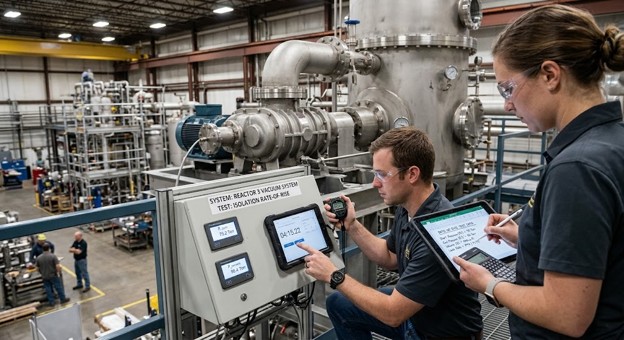
- Pressure-Rise Testing (Rate-of-Rise Test): A practical, on-site static test performed by isolating the vessel, shutting down the vacuum pump, and measuring how rapidly the internal pressure rises over a set timeframe to quickly quantify total in-leakage without complex equipment.
- Helium Mass Spectrometry: Highly sensitive active leak testing utilizing helium tracer gas and a mass spectrometer detector to pinpoint micro-cracks and faulty flange joints, ensuring vessel integrity, protecting product quality, and minimizing long-term operating costs.
Review your application with industry specialists at Vooner – Contact Us