
The landscape of modern industrial vacuum technology is more complex and diverse than at any other point in engineering history. For a facility seeking the optimal balance of performance and efficiency, the sheer variety of mechanical designs can be overwhelming. Engineers must evaluate and choose between a wide range of distinct technologies:
- Rotary Vane Technologies: Available in single or two-stage configurations, utilizing either oil-flooded, oil-less, or once-through oiling designs.
- Rotary Screw Technologies: Offered in both dry (oil-less) and lubricated models for continuous high-displacement operations.
- Rotary Piston Technologies: Robust single or two-stage positive displacement machines built for heavy-duty industrial environments.
- Liquid Ring Systems: Single or two-stage configurations operating as either vacuum pumps or compressors, which can be deployed in once-through, partial recirculation, or full-recovery arrangements.
- Dry Claw Technologies: High-efficiency non-contacting claw pumps or compressors designed for oil-free environments.
- Dynamic & Hybrid Systems: Roots-type rotary lobe blowers, regenerative blowers, or sophisticated multi-stage hybrid systems combining mechanical superchargers with steam/gas jets and surface condensers.
Because every mechanical design possesses unique performance curves and limitations, selecting the correct technology requires a deep dive into specific process conditions, application variables, and long-term reliability requirements.
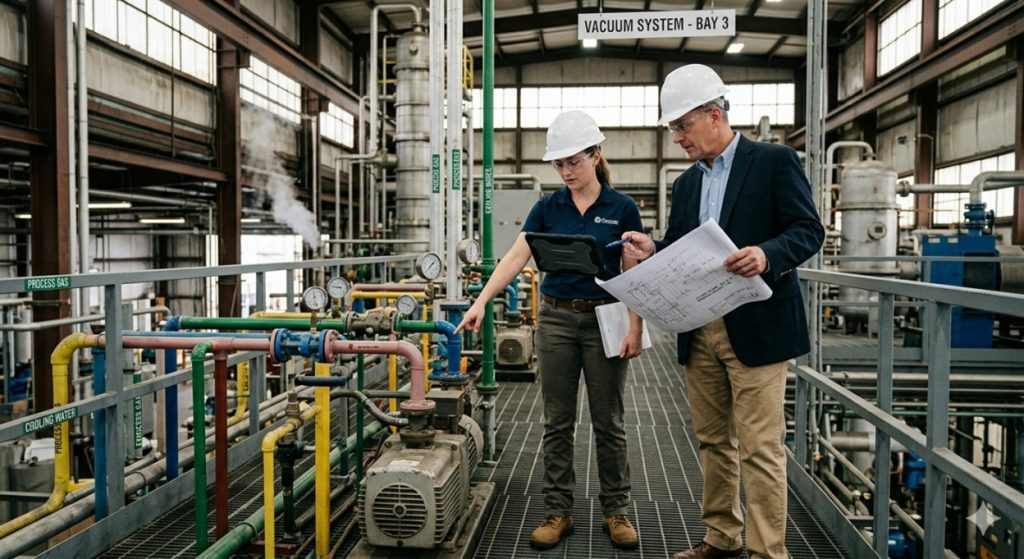
- Process Conditions and System Requirements
Accurate system sizing requires a thorough evaluation of the physical environment and the exact properties of the gas matrix being handled:
- Ambient and Atmospheric Conditions: A system’s ultimate capabilities are directly impacted by site altitude and local barometric pressure fluctuations. Higher elevations feature lower baseline atmospheric pressures, which thins the ambient air and requires precise specification adjustments to ensure the pump can achieve its target vacuum level.
- Pressure Parameters: Sizing requires a strict definition of both the working pressure (the target absolute vacuum level at the process inlet) and the discharge pressure (the counter-pressure at the exhaust point where the gas is expelled). The selected technology must efficiently cross this pressure differential without overloading the motor or causing internal overheating.
- Temperature Profiles: The temperature of the incoming process gas directly influences volumetric efficiency, vapor pressures, and internal material expansion. Simultaneously, the temperature and flow rate of available cooling water dictate the thermal management efficiency of jacketed pumps or inter-stage coolers.
- Mass Flow and Volumetric Capacity: The pump must be precisely matched to the system’s true process load, balancing physical volumetric flow (ACFM) with true molecular mass flow (lb/hr). This evaluation must account for baseline system air leakage rates, as high ambient leak rates artificially inflate the demand on the pump, driving up utility consumption and operating costs.
- Evacuation Mechanics: For batch operations, rapid drawdown or pump-down times are often critical. The system must provide high initial volumetric speed at higher pressures to meet these cycle time targets. Additionally, the process chemistry will dictate the integration of ancillary hardware, including pre-condensers, inter-condensers, after-condensers, knockout pots (KOPs), scrubbers, inlet filtration modules, and receiver vessels.
- Reliability, Process Tolerance, and Maintenance
Beyond baseline flow and pressure, a vacuum pump must withstand the harsh realities of the specific process environment over years of continuous operation:
- Particulate and Content Tolerance: If a process stream carries entrained solids, the technology must possess a high mechanical tolerance for particulates, or utilize specialized inlet filtration to prevent severe abrasive wear and internal rotor damage.
- Moisture and Condensables Management: High-moisture streams or saturated vapors can condense inside a cool pump casing, contaminating lubricating seals, accelerating corrosion, and drastically reducing volumetric capacity. Mitigating these risks requires robust designs capable of handling condensable vapors through the strategic deployment of gas ballasts, automated start/stop purges, or upstream condensation.
- Hydraulic and Shock Resistance: The system must be evaluated for its vulnerability to sudden liquid slugs. Liquid entering a dry mechanical chamber can cause catastrophic hydraulic shock; therefore, technologies must be selected for their inherent ability to tolerate or automatically isolate liquid carryover.
- System Upsets and Corrosive Environments: A resilient system must maintain stability during sudden air leakage surges, cooling water failures, pre-condenser upsets, or unexpected spikes in discharge backpressure. Furthermore, operations handling aggressive or acidic vapors demand specialty metallurgy, corrosion-resistant coatings, and chemically inert sealing fluids.
- Maintenance Logistics and Field Skills: The mechanical complexity of the selected vacuum technology must align with the capabilities of local maintenance personnel. Highly specialized, tight-clearance dry pumps may require specialized field training or expensive factory overhauls, whereas traditional lubricated systems may only require standard plant maintenance skills.
Conclusion
Sizing and selecting the ideal vacuum system requires a multi-dimensional balancing act between initial capital cost, utility efficiency, process compatibility, and long-term maintenance overhead. By systematically auditing your facility’s specific altitude, pressure targets, temperature constraints, flow dynamics, and chemical risks, you can ensure your operation receives a bulletproof, optimized vacuum solution tailored specifically to your application.
Vooner technical consulting services are available to help your team navigate these complex engineering variables, fast-tracking the selection process to deliver a reliable, highly efficient system design.
Review your application with industry specialists at Vooner – Contact Us