
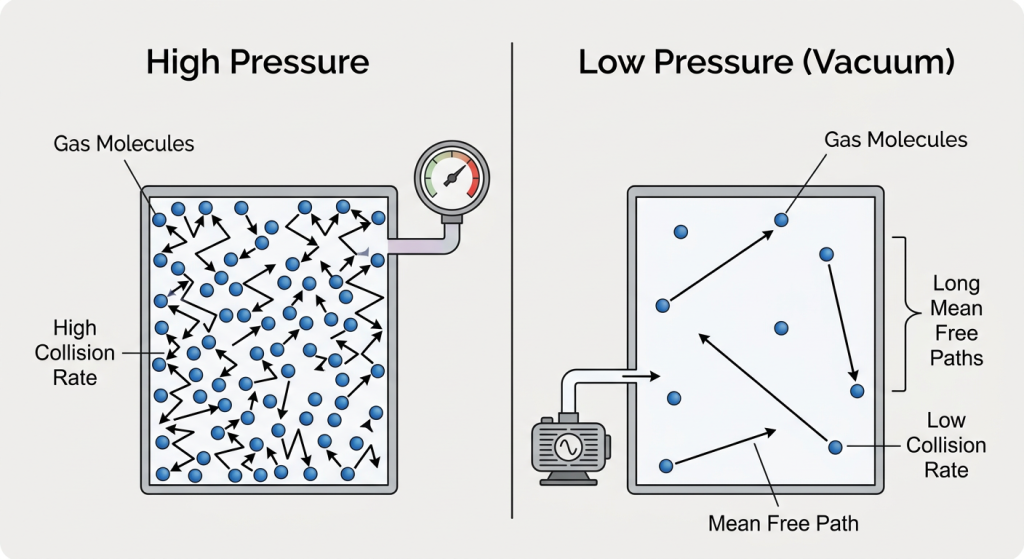
Understanding the behavior of gases is the cornerstone of effective vacuum system management. In the pressure ranges where most industrial processes operate—from atmospheric pressure down to 10-3 Torr—the transition from “dense” gas to a rarefied state dictates how a system will respond to changes in environment and load.
For technicians and engineers, mastering these laws isn’t just academic; it is the difference between identifying a leak and misdiagnosing a failing component.
The Fundamental Gas Laws
To manage a vacuum system effectively, one must understand the inverse and direct relationships between pressure, volume, and temperature.
Boyle’s Law: Pressure and Volume
Boyle’s Law states that for a fixed amount of gas at a constant temperature, the pressure and volume are inversely proportional.
Definition: When the pressure decreases, the volume increases (P1V1 = P2V2).
In a vacuum context, as you reduce the pressure in a chamber, the “actual” volume of the gas expands. This is why a tiny amount of liquid or a small leak at atmospheric pressure becomes a massive volume flow (CFM) load for the system to handle once under vacuum.
Charles’s Law: Volume and Temperature
Charles’s Law states that for a fixed amount of gas at a constant pressure, the volume is directly proportional to its absolute temperature.
Definition: When the temperature increases, the volume increases (V1/T1 = V2/T2).
For service teams, this explains why gas ballast or process heating changes the demand on the system. Hotter gas occupies more space, requiring higher volume flow capabilities to maintain the same vacuum level.
Gay-Lussac’s Law: Pressure and Temperature
Gay-Lussac’s Law states that the pressure of a gas is directly proportional to its absolute temperature when the volume is kept constant.
Definition: When the temperature increases, the pressure increases (P1/T1 = P2/T2).
This is critical when troubleshooting “pressure creep” in a sealed-off system. If a chamber is sitting under a heat source, the rise in pressure may be a thermal effect rather than a physical leak.
Volume Flow vs. Mass Flow
A primary point of confusion in the field is the distinction between how much space a gas occupies versus how much “stuff” is actually there.
- Volume Flow (CFM): This measures the actual cubic feet per minute of expanded gas moving through the pipes at the current operating pressure. As the pressure drops, the CFM required to move the same amount of air increases dramatically because the gas is less dense.
- Mass Flow (SCFM / SCCM): This measures the flow as if the gas were at Standard conditions (14.7 PSIA and 68°F). This represents the actual number of molecules (the mass) being removed.
Why it matters: An engineer might see a high CFM reading and think the system is moving a lot of air, but if the pressure is very low, the SCFM (Mass Flow) is actually quite small. Conversely, a small leak of 1 SCCM is a tiny mass, but at deep vacuum, that gas expands to occupy a massive volume, potentially stalling the system’s ability to reach its target pressure.
Why Technical Proficiency is Required
- Diagnostic Accuracy
Without understanding Boyle’s Law, a tech might see a pressure rise and assume a mechanical failure. In reality, they may be witnessing outgassing—where trapped molecules expand into the vacuum volume. Distinguishing between a “real leak” (mass flow from outside) and a “virtual leak” (trapped gas expansion) is impossible without these laws.
- System Sizing and Scaling
Engineering must calculate the conductance of piping. Because gas expands as pressure drops (Boyle’s Law), a pipe that is sufficient at atmospheric pressure will “choke” the flow at lower pressures because the volume flow has increased beyond the pipe’s physical capacity.
- Safety and Integrity
Understanding the Relationship between Temperature and Pressure (Gay-Lussac) ensures that technicians do not over-pressurize components during cleaning or bake-out cycles. It also helps in predicting how a system will react when gas is suddenly introduced to a warm chamber.